info@uscha.dev · github.com/andresmassello · linkedin.com/in/amasselloLLM coding agents fail in two well-documented ways: when instructions are underspecified they guess instead of stopping, and when a verification signal is visible they optimize the signal rather than the requested outcome. We present Uscha, a methodology for specification-driven development with LLM coding agents organized around a single discipline: gates that read facts block; gates that guess over prose advise. The methodology contributes (i) two specification fronts — a greenfield front where the agent proposes the system shape under one-question-at-a-time human approval, and a brownfield front where the agent extracts verifiable facts and may author only candidate claims in quarantine, promoted to the contract by human verdict alone; (ii) a deterministic evidence ledger with a two-tier record contract in which measured artifacts always override agent self-reports; (iii) a family of executable fact gates (golden non-authorship, gate-integrity, simplicity budgets, per-criterion measured acceptance, regression capture, a derived — never self-declared — workflow state machine) and a structured-guess layer (versioned qualitative rubrics with mandatory evidence, and deterministic clone-vs-repository detection that surfaces the duplication a diff-local simplicity gate cannot see) that advises by default and gates only by explicit human declaration; and (iv) a strict placement of the human at three fixed points: approving the shape, approving the golden baseline, and merging; and (v) a closed forward/reverse cycle — the specification package with its behavior ledger and intermediate representation as the canonical asset of a system, code as a regenerable build artifact, an LLM as the compiler under a validated output contract and reverse discovery as the decompiler — stated as a thesis and put under its own instruments rather than asserted. The methodology also applies its own Lean discipline reflexively: a meta-invariant that keeps a growing set of good gates from becoming an audit (over-processing waste), enforced by collapsing every persisted gate into a single readiness verdict. A reference implementation (nine agent skills and a dependency-free Python engine with 56 subcommands and adapters for eleven language stacks) is described, together with its design validation: two adversarial audits (231 agent evaluations) that initially found the central principle inverted in code and drove its re-wiring; a systematic cross-examination against classical software-engineering doctrine that produced ten shipped improvements; and sustained self-application, in which fresh-context reviews repeatedly caught real defects before merge across the release series. We report design validation, self-application, and one bounded controlled evaluation — the Diamond program, a blind, oracle-certified benchmark of implementation replaceability across twelve archetypes, compiled by four models across two vendors and qualified by a measured noise floor; a controlled evaluation on external operators remains future work.
Two recent empirical results frame the problem this methodology addresses. First, when task instructions are underspecified, production coding agents do not fail closed: they act on unstated assumptions, and a majority of runs violate at least one action boundary [1]. Second, when a verification oracle is visible to the agent, near-perfect scores can coexist with an undelivered artifact: the agent builds to the test, optimizing the check rather than the request, and does not on its own validate what it ships as a user would [2]. Both failures are dispositional rather than capability failures, and both worsen as agents are given more autonomy.
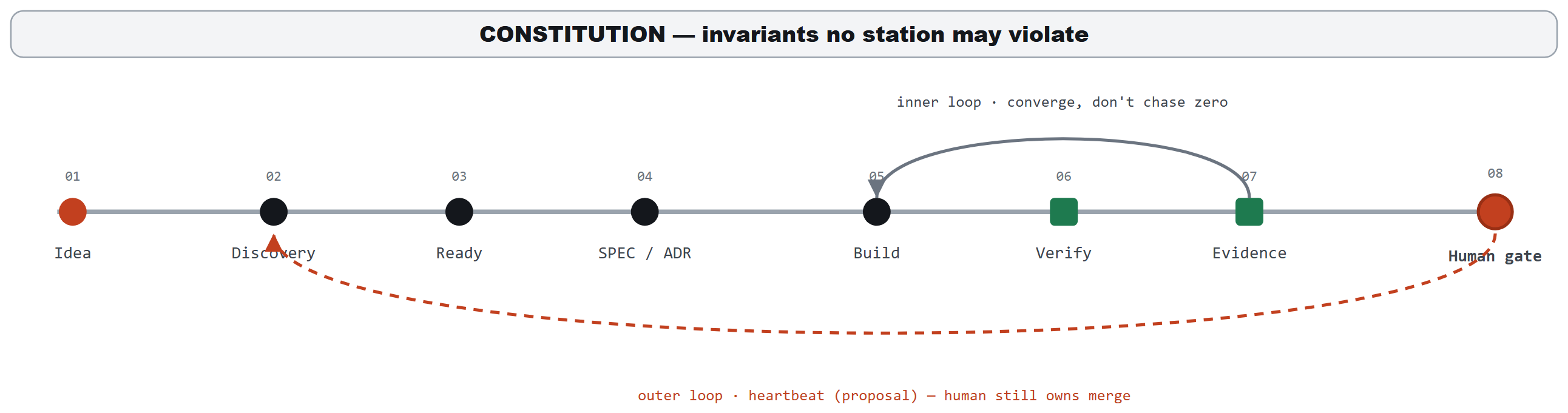
Existing agent development frameworks converge on persistent artifacts and human review as mitigations [3], but they largely encode their process as prose instructions that the agent may ignore, and their verification signals rarely distinguish between what is mechanically verifiable and what is a model's opinion. Uscha (“Uscha” is the name of the methodology; the pattern it operationalizes is a spec-loop — a specification-driven build-and-verify loop. The name was chosen partly to avoid collision with spec-loop [18], an independently developed, actively maintained open-source project that shares the term and the spec-driven, review-per-increment philosophy while taking a different implementation path (shell-based reusable agent skills, task-local specifications); it was found late in this work's development, and the two are convergent rather than derivative) starts from that distinction and makes it the organizing principle of the whole process. Figure 1 shows the resulting pipeline: eight stations from idea to human gate, under a constitution of invariants that no station may violate, with an inner convergence loop over the build and an outer proposal loop that returns to discovery — while the merge remains human.
A useful way to see the resulting shape is as a choice of control flow. The default agentic pattern is an open loop — investigate, edit, test, and then let the agent answer “is it resolved?” itself — and that self-assessment is exactly the signal the two results above show to be unreliable. Uscha instead runs the same work through a measured graph: the steps become defined stations whose transitions are gated by computational evidence in the ledger rather than by the agent's own verdict. The loop is not removed but bounded — it lives inside one station (build–verify convergence) that either converges or escalates to a human when it stalls, instead of iterating on the model's judgment of its own doneness. What the practitioner authors is not the topology, which is fixed, but the guardrails the graph may not cross: the specification, the acceptance oracle, and the constitution of invariants.
The methodology is built on one discipline and three architectural commitments:
The rest of the paper places the approach against related work (§2), then describes the methodology (§3), its evidence engine (§4), the reference implementation (§5), and the design-validation evidence accumulated so far (§6), followed by limitations (§7) and future work (§8).
Underspecification. Ji et al. [1] show that underspecified operational instructions cause agents to guess rather than stop, violating action boundaries in 55.8–67.8% of runs. Uscha's greenfield front is a direct response: the specification is produced through a structured interrogation in which the agent proposes and the human decides, and inviolable constraints are captured in a constitution file whose breach is a first-class blocker, never a trade-off.
Building to the test. Ma et al. [2] demonstrate that agents deliver what is checked, not what is requested, and name the missing disposition validation self-awareness. Uscha treats this as its central adversary: acceptance closes per criterion on measured test evidence; findings cannot be closed without new test material (find bugs once); qualitative verdicts require file-and-line evidence or they do not count; and the workflow state that authorizes a pull request is derived from ledger facts, never self-declared by the agent.
Process taxonomies. de Macedo [3] surveys agent development frameworks along six dimensions (specification, context, roles, execution, validation, portability) and identifies recurring risks: specification drift, artifact fragility, and platform dependence. Uscha addresses each explicitly: drift through a rebuild test that scores whether the specification package alone can regenerate the system; fragility through an integrity-checksummed ledger; and platform dependence through the contract architecture and a dependency-free engine.
Field-level evidence and the autonomy trajectory. A systematic review of agentic AI across the software development life cycle [16] finds agentic support concentrated downstream — implementation, testing, maintenance — while the upstream phases (requirements, specification, design) remain the least mature, and it identifies output verifiability as the primary enabler of adoption. Uscha is a direct wager on that gap: it invests its heaviest machinery precisely upstream, where that review reports agentic support to be thinnest, and makes verifiability — not autonomy — the axis it optimizes. The framing is deliberately narrow: the review establishes that the upstream, verifiability-first niche is real and underserved; it does not, and cannot, measure Uscha itself, whose own evidence remains design validation and self-application (§6). The complementary direction is the autonomy-first multi-agent framework, of which ALMAS [17] is representative: specialized agents aligned with agile roles drive the loop toward less human involvement. Uscha takes the opposite stance on the same problem — the human stays at three fixed decision points (shape, golden, merge), and the reviewer's verdict is a recorded ledger fact backed by file-and-line evidence, never one more agent's self-report.
Practitioner doctrine. The methodology's check classification adapts the computational-versus-inferential distinction from Böckeler's sensor framework for coding agents [11, 6] — the axis on which “facts block, guesses advise” rests. Its gate-integrity stance — that a change must not weaken the apparatus that measures it, and that a high-blast-radius change needs a checker uncorrelated with the maker — follows the agentic-code-review red flags catalogued by Osmani [12]. Architecture decision records follow Nygard [5], extended with machine-checkable implementation plans. Golden-master capture follows approval-testing practice [7], with one addition central to the method: the agent may author the capture harness but is mechanically forbidden — by a pre-tool-use hook, not by instruction — from writing an approved fixture. The simplicity gate operationalizes the “Reduce” law of Maeda [13]. The methodology was also systematically cross-examined against classical doctrine [4]; §6 reports the ten resulting improvements. Two agent-native failure modes complete the lineage: the premature “done” token — Huntley's Ralph Wiggum loop [14] — is exactly what the derived state machine and objective gates refuse to accept, and the maker-checker separation the review loop enforces is the evaluator-optimizer pattern [15]. The design stance throughout is an application of Goodhart's law [8] to agent verification: any signal the agent can see, it will eventually optimize.
Independent evidence for the premise behind check-terminado arrived from
a different scale: Cursor’s report on a week-long, thousands-of-agents build with
no human in the loop [19] states that its first harness failed because the model
proclaimed success while far from it, and that output quality tracked the quality of
the specification rather than the infrastructure. The same report removed its
independent judge as a bottleneck at that scale, which this paper does not attempt
to reconcile: the single-agent setting studied here has the gate as its only
correction mechanism, and a scale criterion for when a gate stops paying for itself
is stated as an open question, not a result.
Independent evidence at the review stage, rather than the build stage, comes
from Garg [20]: a controlled study (accepted at GAISS 2026) found that a
specification baseline did not raise reviewers' bug-detection rate over
code-only review — the two were statistically indistinguishable —
but raised the share of findings attributable to a named, approved
requirement from zero to a majority. A reasoning-first baseline with no
specification captured nearly all of the apparent gain on simpler tasks, and
specification-anchored review cost more reviewer time. This is a different
measurement than the Diamond program's replaceability claim — reviewer
attribution and time, not regeneration under a withheld oracle — and is
not presented here as validation of it; the confound the source itself
names, that part of the effect attributed to “specifying first”
may be a reasoning effect rather than the specification, is stated as the
source states it.
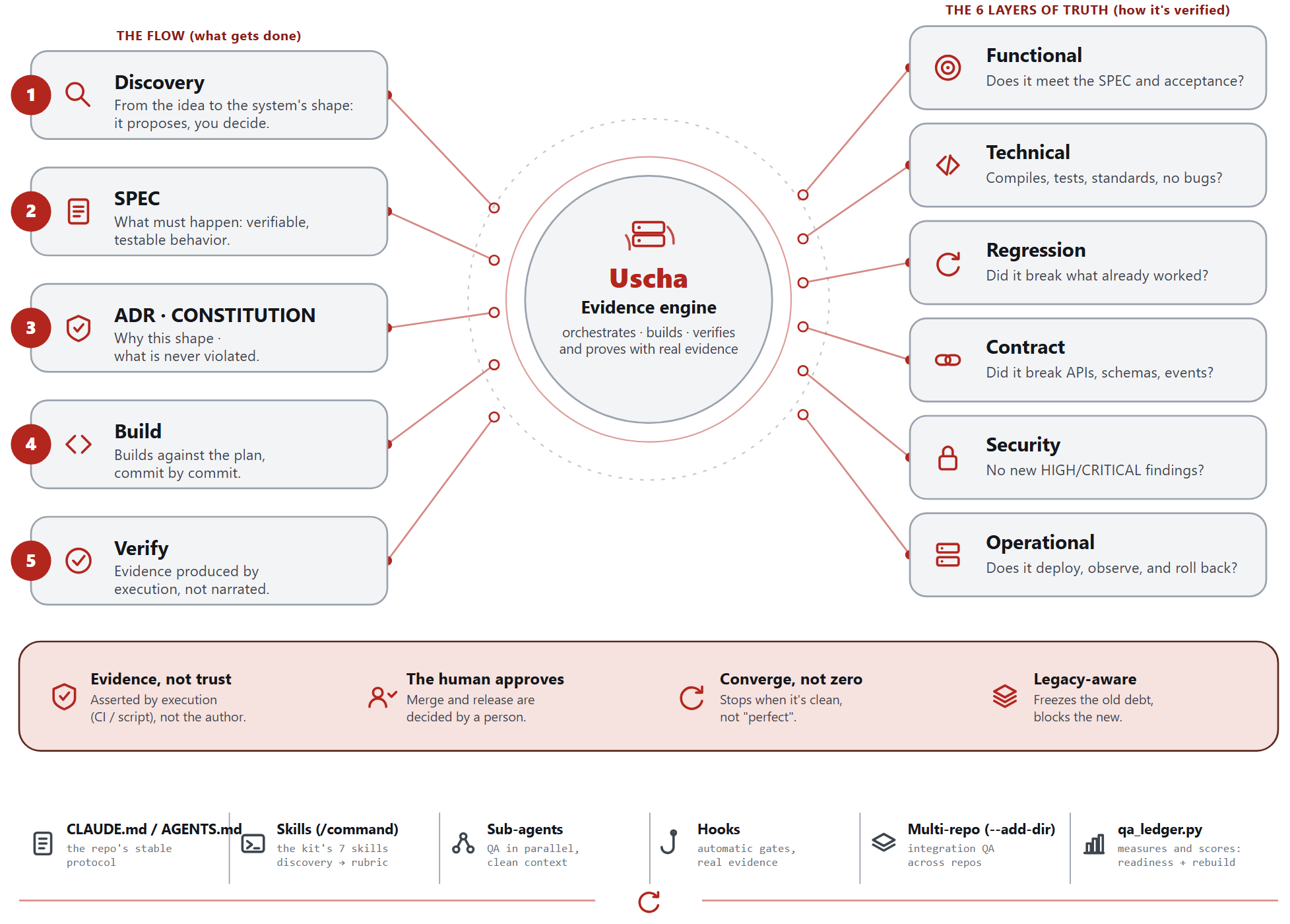
Greenfield (discovery). The human brings an idea; the agent brings the shape. The front proceeds one question at a time, each question carrying the agent's recommended answer, walking a fixed agenda: purpose, domain model, operation surface, architecture options with trade-offs, dirty cases and failure behavior, inviolable constraints, out-of-scope, acceptance criteria with stable traceable identifiers, a declared quality bar, and residual risks. High-uncertainty risks trigger a time-boxed spike whose only legitimate output is a decision record with lessons — spike branches are mechanically refused at the pull-request gate. The front emits a versioned specification package: context glossary, constitution, domain model, specification, decision records with implementation plans and verification checklists, acceptance file, risks, and handoff. Figure 2 shows how the package's artifacts feed the evidence engine and how the engine verifies the result across six layers of truth.
Brownfield (reverse discovery). For an existing system, the
direction of trust inverts: observable behavior is ground truth, and the agent
begins by producing facts — a system map from static analysis and a
golden suite captured mechanically at the boundaries. The methodology's original
rule went further and forbade the agent from authoring any specification of what
the old system does: an agent-written specification encodes the same partial
reading of the code that loses behavior silently, which is precisely the blind
spot the golden exists to counter. That prohibition was later renegotiated into
a quarantine: the agent may author candidate behavioral claims, each
carrying typed evidence (test, code, or
inference) with machine-resolved references confined to the
repository tree and a bounded confidence (inference is always low) — but
no candidate reaches the forward flow without a recorded human verdict,
preserve, fix, or undefined, in an
append-only behavior ledger verified against version control. The gate is
measured, not promised: a candidate with no verdict blocks the pull-request
state, naming itself. The three verdicts matter because legacy code mixes
intent with accident — bugs that customers depend on, timeouts nobody
decided — and a naive extraction fossilizes the bugs as features. A
fix verdict declares its expected divergence, which the golden
oracle then checks (a declared divergence that fails to appear reads red), and
an advisory round-trip report traces promoted candidates back into the code by
identifier. “Never author” became “never promote without
judgment”: the human stops authoring text and authors verdicts, and
writes the migration specification from judged candidates only.
The loop consumes the specification package and proceeds through phases, each guarded. It opens with planning (constitution first; no acceptance criteria, no build) and a coverage gate that triggers boundary characterization tests when the safety net is insufficient. The build itself runs under decision-record discipline: the agent consults the records before touching governed areas and must propose — never silently take — new architectural decisions, while a simplicity gate scores the diff against declared budgets, with test code excluded so that writing tests is never penalized. Verification is a severity-gated review loop that converges instead of chasing zero (findings below the declared gate are deferred, not fixed forever), followed by an integration pass across repositories, late test-writing against stabilized code, and an optional rebuild test measuring specification completeness. A pull request opens only when the derived workflow state says the facts allow it. The loop stops at merge: merging is human.
An escalation contract enumerates the situations in which the agent must stop and ask — iteration cap, oscillating findings, a previously-passing test now failing non-trivially, contradictory tool directives, decisions of architectural weight, and any constitution breach. Escalations and their closures are recorded events; an open escalation caps the readiness score until a human resolves it, and resolving a blocker requires an escape analysis: which gate or test should have caught this, and what was done about it.
Figure 3 walks a deliberately small feature — a discount calculation — through the whole methodology, because the small case makes the failure modes legible. Six of the ten steps are failures or refinements, and that is the point: each deviation is caught by a specific gate rather than by hope. Two advisory passes tighten the specification before any code exists (a vague criterion becomes a testable oracle; a missing out-of-scope section is added). During the build, mutation testing exposes a test that runs but asserts nothing (coverage was lying); the gate-integrity check catches and blocks the agent lowering a threshold to pass; the rebuild test diverges on an implicit input case, and the response is to amend the specification, never the code; the simplicity gate cuts a speculative abstraction. Only then does the readiness score — capped by facts, dominated by measured acceptance — reach the human gate, where a person reads the diff and approves the merge.
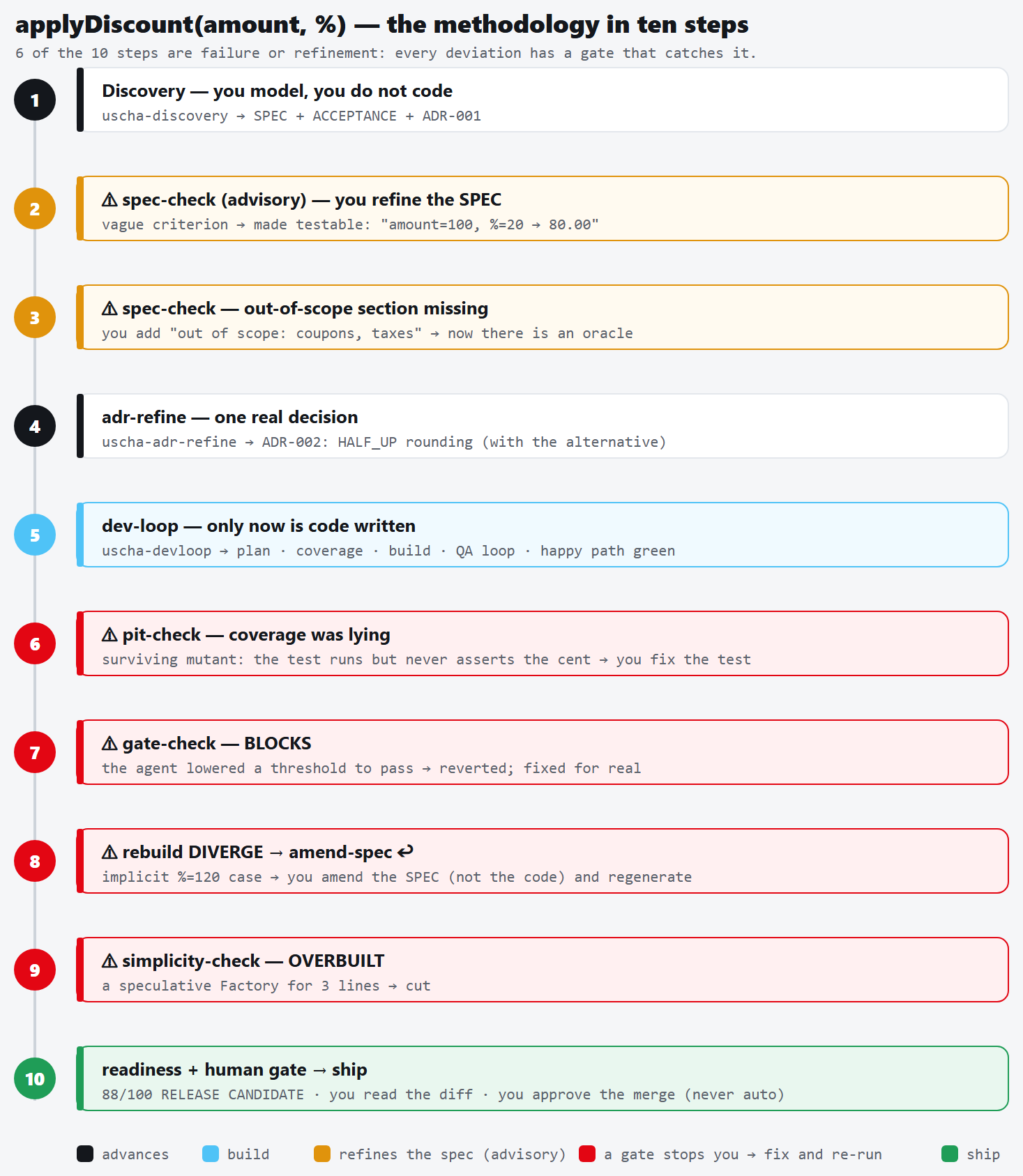
applyDiscount(amount, %)
through the ten steps of the methodology. Black steps advance (blue marks
the build), amber steps refine the specification (advisory), red steps are
gates stopping the agent (fix and re-run), and the final green step is the
human gate. Six of ten
steps being failure or refinement is the expected shape of the process, not
an anomaly.The engine is a single dependency-free Python file. It never runs an LLM and never runs the tools it scores: it ingests their reports (JUnit-family XML, Cobertura and lcov coverage, thirteen linter formats across eleven language stacks) and validates structures. Every verdict is persisted in a deterministic ledger with an integrity checksum; external mutation or a truncated write blocks loading with a recovery message. Table 1 summarizes the complete check family and the verdict class of each.
| Check | Reads | Verdict |
|---|---|---|
golden-diff | byte comparison against human-approved fixtures; declared volatiles masked visibly | blocks |
gate-check | diff structure: deleted/disabled tests (nine stack conventions), lowered thresholds, added secrets | blocks |
pit-check | mutation-testing reports (test effectiveness, because coverage lies) | blocks |
simplicity-check | diff size, indentation-depth proxy, net growth against declared budgets; test code excluded | advises* |
spec-check (structure) | missing sections, zero traceable acceptance identifiers, duplicates, invalid rubric structure | blocks |
phase --require pr-ready | workflow state derived from ledger facts; spike branches always refused | blocks |
readiness | weighted state score with hard caps and threshold provenance | reports |
regression-check | findings closed without new non-blank test lines → narrated closure | advises* |
rubric-ingest | weighted qualitative criteria; evidence-or-nothing grader contract | advises* |
waste-check | Type-1/2 clone windows of the diff vs the repository — the duplication a diff-local gate cannot see | advises* |
spec-check (prose) | vagueness and shape heuristics over specification text | advises* |
Fact gates (block). The blocking gates read artifacts, not opinions. Two design choices deserve emphasis. First, the golden gate's masking of volatile fields (timestamps, request identifiers) is itself governed: masking rules are declared in a versioned file that the human approves together with the fixtures, every masked match is reported separately, and any later edit to the rules file is flagged — masking is never invisible. Second, the workflow state machine is derived: the state (plan, build, qa, escalated, pr-ready) is computed from ledger facts. A self-declared state machine would be narrated state — the exact category of signal the methodology distrusts — so there is nothing to declare and no illegal transition to police.
Structured guesses (advise). The advisory layer includes
regression capture (closing findings without adding a single non-blank test
line is flagged as narrated closure; the failing test goes before the
fix); plateau and stop-signal advisories over the finding history (findings
flat or rising across three complete cycles means more iteration is not
approaching the solution — return to the decision records; everything
converged with zero blocking facts means cut and ship); and the rubric layer:
a versioned file of weighted qualitative criteria — conventions,
error-handling sanity, interface ergonomics, documentation quality — with
anchor examples, negative criteria, and a threshold, graded by any runner
against a JSON contract with evidence-or-nothing semantics: a verdict that
affects the score without a file-and-line citation does not count, duplicate
verdicts for one criterion break the contract, and unevaluated criteria count
as failed (unevaluated is not approved). The advisory layer also carries
reuse detection: a deterministic Type-1/Type-2 clone check of the diff
against the existing repository. This targets the duplication that a diff-local
simplicity gate is blind to by construction — the form of waste most
characteristic of generated code [9, 10]. It too reports a fact (a byte-identical window
already exists at file:line) while leaving the verdict
“wasteful” advisory, because a normalized-line proxy has honest
false positives (boilerplate, data-transfer objects, embedded SQL) and a check
that blocks on those would be disabled and die.
Readiness and the anti-ceremony invariant. A weighted 0–100 score reports the state of the result, never effort (Table 2). The dominant dimension is measured acceptance — criteria closed by green, name-tagged tests — with checkbox completion demoted to a narrative dimension. Hard caps override the weighted average, and every biting threshold states its provenance. The score reports; it does not gate — the gates are the facts above. As the gate set grows, the dominant risk shifts from any one bad gate to the sum of good ones making the loop feel like an audit — over-processing, the ceremony form of waste. The methodology answers this reflexively with a meta-invariant every future gate must satisfy (it runs without human input, speaks only when it matters, collapses into readiness, and a trivial change skips it), mechanized as a single-verdict view: readiness collapses every persisted gate into one line, expandable on demand. This is the same Lean lens the method applies to code, turned on the method itself [9].
| Dimension | Weight | Measured from |
|---|---|---|
| acceptance (measured) | 30 | criteria closed by green, name-tagged test cases in ingested reports |
| static gate | 20 | latest linter runs, normalized severities; never-ran scores 0 (silence is not success) |
adr (narrative completion) | 15 | checkbox ratio of the acceptance file — narrated progress, deliberately demoted below measured acceptance |
| coverage | 15 | coverage reports against the declared threshold |
| convergence | 10 | clean last cycle of every review tool plus clean persisted fact gates |
| integration | 10 | cross-repository contract pass (weight redistributed if disabled) |
The reference implementation packages the methodology as nine agent skills
— the two specification fronts (discovery,
reverse-discovery), a Socratic interview for an already-scoped
feature (adr-refine), the loop orchestrator (devloop),
golden capture (characterize), a two-audience documentation
generator (sysdoc), the rubric grader adapter (rubric),
and two read-only status views, a dashboard (mirador) and an in-chat
readout (status) — plus the engine (56 subcommands). Three
properties matter for portability. First, the skills are markdown instruction
files readable by any instruction-following agent; the engine is invoked
identically from any of them. Second, every LLM-judgment interface is a
contract: the rubric grader ships as a neutral prompt usable by any vendor's
agent, a raw API call, or a human filling the JSON by hand — the
implementation's test suite exercises exactly that path, with no LLM in the
loop. Third, the one mechanical prohibition (the agent must not write approved
golden fixtures) is enforced by a pre-tool-use hook at the runtime boundary,
not by instruction — during development of the implementation itself the
hook blocked one of its author's own commands, which is the property working
as designed. Table 3 maps the nine skills to the phase each serves.
| Skill | Front / phase | Role |
|---|---|---|
discovery | greenfield front | idea → spec package, one question at a time; the agent proposes the system shape |
adr-refine | known-feature front | Socratic interview → SPEC + decision records + acceptance for an already-scoped feature |
reverse-discovery | brownfield front | extract facts (system map + boundary golden) + candidate claims in quarantine; never promotes without a human verdict |
characterize | pre-change | capture the approval suite of current behavior — the one artifact the agent must not author |
devloop | the loop | plan → build → severity-gated review loop → derived PR gate; records every step in the ledger |
sysdoc | reporting | two-audience (commercial + technical) HTML deck generated from the ledger |
rubric | advisory gate | thin adapter that grades against a versioned RUBRIC.md via the vendor-neutral JSON contract |
mirador | reporting | read-only dashboard rendered from the ledger: readiness, measured acceptance, loop burn-down, and per-figure receipts |
status | reporting | the same measured facts as a one-line in-chat readout, for surfaces with no persistent status line |
The implementation carries its process in executable form. A smoke suite of
457 checks (at kit 2.2.0) exercises the implementation — the engine
against synthetic ledgers, plus the installer and the distribution router
— including,
deliberately, the agnosticism claim: the rubric-layer tests fill the grader's
JSON by hand, with no model in the loop. The same run measures the
implementation's own acceptance criteria the way the methodology prescribes for
any project: 329 of 330 closed on green, name-tagged test evidence at that
version. The engine also reports a passive Lean
process metric — first-time yield, the fraction of repositories that
cleared QA on the first cycle with no rework or escalation — derived from
ledger facts and kept strictly informational, never a gate: it measures the
process, not the state of the result. Version consistency across the six
release artifacts (version file, configuration, two plugin manifests,
marketplace manifest and package manifest, plus the matching changelog) is
itself a suite check, converting a release convention
into a verifiable fact. An installation-diagnosis subcommand in the spirit of
flutter doctor verifies interpreter, per-stack toolchains, hook
presence and registration, skill integrity, and per-project configuration
— and every failing check carries its remedy (an installation link or
command), so the workflow is: run, install what is listed, re-run until green.
Three installation modes are supported: per-project, per-user, and as a
packaged plugin for one agent runtime — packaging, not dependency; the
other runtimes install by copying files.
No controlled external evaluation has been conducted yet; we report the design-validation evidence honestly and completely.
Adversarial audits. Before stabilization, the methodology and its implementation were subjected to two adversarial audits totaling 231 agent evaluations: a seven-lens audit (54 agents; findings attacked by skeptics defaulting to refuted) confirmed 33 weaknesses and refuted 13, with the central finding that the core principle was inverted in the code — fact gates existed but were not wired to block. A second audit verified 171 claims across documentation, code, and design intent. The response re-wired every fact gate into the engine and re-passed all documentation against the implemented reality (a recorded truth-pass over the affected documents), converting the principle from slogan to enforced property.
Doctrine cross-examination. The methodology was systematically read against classical software-engineering doctrine [4], producing a set of validations, tensions with recorded resolutions, and ten actionable improvements that shipped as separate releases with their own regression checks (the per-item tally lives in the release changelogs rather than in a single committed artifact, and is stated here at that level of evidence). The validations were often word-for-word: “don't assume it — prove it” is the ledger's two-tier contract; shared mutable resources including files motivated the ledger's integrity checksum; and the doctrine's warning against trusting enforcement to good intentions is exactly why the golden prohibition is a hook rather than an instruction. In the two deepest tensions the methodology deliberately departed from the letter of the doctrine to defend its own principle: readiness caps continue to bite by default (their existence is a definition; only the numbers are opinion, and they now state their provenance), and the workflow state machine is derived rather than declared.
Self-application. The implementation is developed under its own process. Across the self-application arc (versions 1.10 through 2.2), each engine change carried smoke checks in the same commit, a fresh-context review before merge, and a version consistency check across every release artifact, enforced by the suite. These reviews repeatedly caught real defects prior to merge — the changelogs record the resulting hardening across the series — including: test-file classifier gaps that made a documented guarantee an overclaim; a blank-line loophole in regression-check evidence (any non-blank test line counts as evidence — a tripwire, not a judge — but a blank line must not); a review-suite check that passed for the wrong reason (its precondition never held, so the assertion was vacuous); silent last-wins semantics on duplicated grader verdicts — a grader gaming vector, now a broken-contract error; and, in the single-verdict release itself, documentation that under-enumerated what the collapsed view actually shows. We take the consistency of this defect stream as evidence for the methodology's core premise: independent, fresh-context checking against recorded criteria catches what the authoring context cannot see.
The Diamond program (versions 1.72–1.99): a bounded controlled evaluation. An archetype, in this program, is a system specified completely enough to be built from its specification alone — a token-bucket rate limiter, a request router, a two-module ledger — and small enough that a withheld oracle can decide whether a given build is the same system. Between July and August 2026 the methodology's central claim — that a canonical specification package is the source and code is a build artifact — was put under its own instruments. A Diamond Bench of twelve such archetypes (eleven in Python, one of them a two-module system with a decided seam, and one in JavaScript) was compiled blind — the compiling model never sees the oracle, and its working directory holds nothing but what the prompt puts there — from the canonical package alone, and certified by a withheld oracle authored before any compilation and shown discriminating against a degenerate stub and per-rule wrong implementations.
The first arm ran three compilers of a single vendor (Claude Haiku, Sonnet and
Opus): nine of the twelve archetypes reached PASS and three were PARTIAL, and the
oracle caught a convergent aliasing defect two compilers shared. That arm left
open the question a reader is entitled to ask — is regeneration fidelity a
property of the method, or of one model family? — and version 1.99.0
answered it the only way a single arm can, as a falsification test the claim
survived (ADR-042). A fourth compiler, from a second vendor (the OpenAI Codex
command-line interface driving gpt-5.5), compiled all twelve
archetypes blind under the same protocol and the same withheld oracles, plus
second runs of the ten archetypes that have one: 22 dispatches, all 22 accepted
by the engine's own compilation validator, none re-dispatched to obtain a greener
result. Two mechanical deviations are recorded rather than smoothed over. The
second vendor's tool carries a large system prompt of its own that the first
arm's compilers never had. And because the machine's administrator policy forbids
that tool's exec-mode file writes, the model returned its source inside the
validated JSON and the harness wrote the bytes — defeating an
administrator's security control to make a benchmark run is not a method. The
second deviation removes nothing the bench measures: the number of shell commands
executed is 0 across all 22 dispatches, so neither arm ever ran its own code.
The measured result is 8 PASS, 4 PARTIAL: 8 of 12 archetypes regenerate the
system under the withheld oracle, where the single-vendor arm had read nine and
three. Exactly one verdict moved, and the
move is the point. On transformer the canonical specification says
each input record has “exactly” three named fields and then never
lists an extra field among the error cases; the withheld oracle resolved that
silence one way, the new compiler resolved it the other, declared that reading
in its own unresolved-intent record before the oracle judged it, and
reproduced it in a second blind run. The defect is an under-specification in the
canonical package that three related models had resolved identically —
exactly the blind spot a single-vendor bench cannot see — and it
corroborates, from the opposite direction, what the controlled-language arm had
recorded about the same sentence sixteen releases earlier.
A controlled-language arm compared free-prose authoring of the same package against EARS+STE authoring — the Easy Approach to Requirements Syntax, plus Simplified Technical English — under the same oracle, deconfounded by same-generation runs of both arms, across five archetypes: REDUCED in one, IMPROVED in one, NO EFFECT in two, WORSE in one — dense archetypes helped behaviourally, simple ones did not, and one rewrite sharpened a latent ambiguity into an over-commitment the oracle rejected. The single REDUCED entry (the guard) carries its own qualifiers: it is classified NOISY at an intra/inter ratio of 0.642, and the same comparison reads MIXED under Python 3.8, so by the program's own doctrine structural variance alone no longer carries a claim.
A noise-floor run — second blind runs of the same models, over
the ten of twelve archetypes that have one (ledger-lite and
rate-limiter have none) and at n = 2 per model, the
minimum that yields a floor at all, and a floor rather than a distribution
— reads NOISY overall: SIGNAL in one entry, NOISY in seven, and outright
NOISE in two (scheduler 1.20, worker 1.10), for a mean
intra/inter distance ratio of 0.815, while behaviour is stable (36 of 40 reruns
fail the same oracle cases). The cross-vendor arm moved two entries out of NOISE
(parser 1.13 to 0.73, state-machine 1.12 to 0.81) for a
mechanical reason worth stating: a compiler that is not a relative of the other
three widens the between-compiler spread more than it raises the same-model
floor. Both land within about 0.3 of the class threshold, so the classes are
pinned by the suite and the ratios are not. The program's variance claims
therefore carry a per-entry qualifier, its controlled-language conclusion is
stated behaviour-first, and one earlier variance narrative was retracted.
A round-trip instrument measures how much of the human-authored intermediate representation the mechanical reverse organs can anchor in each compiled artifact, counting static and behavioural footing: mean recoverability 0.815, the same value under Python 3.8 and 3.13. The aggregate is published as a range rather than a float because, before the fourth compiler joined, the per-entry means summed to a value whose twelfth part fell exactly on a rounding boundary and printed 0.828 under one interpreter against 0.827 under the other. The instrument's first release read 0.062, with the behavioural dimension unmeasured in every entry, because no oracle case in the bench was tagged with the acceptance criterion it certifies. Closing that gap was a curation, not a re-measurement: a human tagged the twelve withheld oracles case by case — 201 of the 216 cases tagged, the remaining 15 owned by no single criterion, three tags adjusted by hand — leaving payloads and expectations untouched. What changed is what the instrument can attribute; what the compiled artifacts do did not move. The reverse half of the diamond now anchors names and behaviour.
Every one of these numbers is regenerated by the engine from committed
fixtures and pinned by the suite; most releases passed an independent blind
review before they shipped, with two exceptions that say so in their own
changelogs — 1.74.0 and 1.75.0 were reviewed inline by the author, and the
independent review later run on 1.74.0 caught two report-honesty defects the
inline self-review had missed. Those reviews caught real defects in most releases
— each catch is recorded in that release’s changelog —
including two that changed how a result was stated (a spec found
self-contradictory, a false-precision ratio). Human curation of the
machine-generated code — one verdict per observation, and no observation
promoted without one — is complete as of 2026-09-08: 221 verdicts over all
twelve archetypes and all four compilers, 213 preserve and 8
fix, none left unjudged, the eight fix verdicts naming
defects the oracles had passed. All 221 were recorded by a single curator (the
author), and their coverage per archetype is uneven (43 on the guard, 5 on the
state machine). This is a controlled evaluation of the artifact-level claim; it
is not the operator-level study below.
The release ritual under its own instruments (versions 1.96–2.2, 2026). After the Diamond program the same discipline was turned on the process that ships the implementation, and each of the changes below began as a defect that process found in itself. The ritual became a program. The release procedure had been prose a maintainer re-read; since 1.96.0 it is a script (ADR-041) that performs the steps and refuses, naming which of eight invariants it broke — among them that the version surfaces move together, that the suite runs on the code commit and a non-zero exit is a refusal rather than a note, that the evidence commit carries evidence and nothing else, and that the tag is created after the push, so a red continuous-integration run is a wait and never a publish. The same decision retired a wall clock: whether the project's own ledger is fresh is now decided by version-control ancestry — was the ledger recorded in, or after, the commit that last changed the engine? — which deleted a step whose only purpose had been to keep a timestamp ahead of a commit. Roughly half of the readiness history since August 2026 had been that step, plotting the ritual as if it were the product.
Published claims became a gate. Version 1.97.0 derived the counts a document may claim — version, subcommand count, skill count — from the tree itself, and gated one list of published files against them, rewriting a stale claim in place and failing on one it does not recognise. Version 2.2.0 extended the derivation to the benchmark headline, after the gate was caught missing it: the project's own home page went on claiming nine of the twelve archetypes through nine releases after the cross-vendor arm moved one verdict, because the number sat in one markup element and the noun that gives it meaning in the next, and because no derived fact existed to compare it against. Both halves of that defect were repaired, and a red probe against the previous engine ships beside the check.
Two shipped defaults were found never to have taken effect. Version 2.0.0 measured that the risk presets — which exist to make a trivial change run one review and a high-risk change run three — had never modulated anything in a repository the implementation itself had set up, because the installer copied the reference configuration, so every default arrived as an explicit declaration and outranked the preset by the precedence rule's own terms. The installer now generates a minimal configuration that declares no knob a preset owns. Version 2.1.0 (ADR-043) found the simplicity gate stopping loops on a budget nobody had adopted: a six-line diff scored OVERBUILT because the gate's indentation proxy read one wrapped call argument as nesting depth nine. That gate now advises unless the project declares a numeric budget and asks for gating — this paper's own rule, guesses advise, applied to a check that had quietly crossed into blocking.
Two field retrospectives added evidence classes. Version 2.2.0 carried, from two projects using the method in the field, an origin marker recording who decided a specification item, so that an item the agent introduced and an item the human chose are no longer the same sentence in the same file (ADR-044); a corpus gate that scores a command against a body of real inputs (ADR-046); ingestion of a project's own smoke run as measured evidence rather than a prose checklist (ADR-047); and an operability check reading four facts out of the tree — a pipeline running the repository's configured test command, a workflow publishing a release asset, a runbook naming start, configuration, rollback and smoke, and a declared seed command whose script exists (ADR-048).
No operator-level controlled evaluation. The Diamond
program (§6) is a controlled evaluation of the artifact-level claim
— replaceability under a withheld oracle, with a measured noise floor
— but all of it was run by the methodology's author on bounded
archetypes; effect sizes on team productivity, defect escape rates, or
comparison against the frameworks surveyed in [3] remain unmeasured, and the
structural distance the program uses is coarse (LOC, AST size, imports) and
interpreter-sensitive, which the instrument now states.
Single-operator bias. Self-application shares authorship
context; although reviews run in fresh contexts, they share the model family
and the author's configuration. The same bias reaches the Diamond program's
human layer: all 221 curation verdicts over the compiled artifacts were
recorded by that single operator, with no second curator and no inter-rater
measurement.
Two vendors, and one model of the second. The cross-vendor
arm is a falsification test the replaceability claim survived, not a survey:
four blind compilers, two vendors, and exactly one model (gpt-5.5)
of the second, at n = 2 runs. Nothing here measures a vendor,
and nothing generalizes to language models at large.
Noise-floor coverage. The floor that qualifies every variance
statement rests on ten of the twelve archetypes at n = 2 per
model; it is a floor, not a distribution, and two archetypes have no second run
at all.
Structural distance on JavaScript. The distance function is
three-dimensional for Python (lines of code, AST size, import Jaccard) but
two-dimensional for the JavaScript archetype: no standard-library JavaScript
AST is available, so ast_nodes reads UNMEASURED and the two arms
are not directly comparable on that axis.
LLM non-determinism. The rubric layer's grades vary across
runs; the methodology bounds the blast radius (advisory by default,
evidence-or-nothing, human-declared gating) but does not eliminate variance.
Scope. The loop targets a single operator driving one
non-trivial change; multi-operator concurrency is out of scope, and the ledger
is single-writer by design.
Heuristic residue. Some gates carry documented
approximations; each is disclosed at the point of use, but disclosure is not
elimination. Three are worth naming. Path-based test classification and
stale-report windows are approximations of what the engine cannot see directly.
The simplicity gate's max_nesting is an indentation proxy,
not a measure of nesting: it divides the leading indentation of added lines by
the configured indent width, so wrapped arguments, JSX and multi-line literals
inflate it — which is why the gate advises unless a budget is adopted
(§6). And the operability check grades presence, not quality: it can
see that a runbook names a rollback section and that a workflow runs the
configured test command, not that the procedure is correct or the tests
meaningful.
Field evidence is instrumented, not yet weighted. The corpus
gate scores a command against real inputs and blocks through its own record, but
readiness gains no field dimension and no weight from it: adding a
weighted dimension moves every existing project's score on upgrade, so it is
deferred to a decision record of its own rather than smuggled in beside the
instrument that would feed it.
No control for reasoning-first. Independent evidence [20]
found that prompting a model to reason about edge cases with no specification
captured most of the apparent benefit on simple tasks; this paper does not
isolate a reasoning-only baseline from the specification-driven flow, so the
quality claim made here is defensible only for the multi-constraint work the
methodology targets, not for simple tasks in general.
Reviewer cost is unmeasured. The human cost of
spec-anchored review — measured elsewhere [20] as a substantial
increase in reviewer minutes — is not measured in this work.
The central gap is operator-level controlled evaluation. Concretely, we plan a study that assigns matched non-trivial changes to operators with and without the methodology and measures three outcomes the ledger already instruments: defect-escape rate at human review, rework (first-time yield across cycles), and time-to-merge — against two baselines, ad-hoc agent use and the frameworks surveyed in [3] along their six taxonomy dimensions (with particular attention to the validation and portability axes). The missing pieces are operators other than the author and a controlled task set; the process instrumentation is already in place. Supporting steps: read-only dry runs of all eleven stack adapters against real repositories; a multi-project dogfooding phase; and an evaluation of the rubric layer's inter-run variance under anchored versus unanchored criteria, connecting to the validation self-awareness agenda of [2]. A further direction extends the Lean lens beyond the inner loop: the reuse and anti-ceremony gates address two forms of waste (duplication and over-processing), but the “shine” discipline of 5S — scheduled cleanup that keeps the legacy layer from silently freezing — is a candidate outer-loop routine [9], deliberately out of scope here because it acts on the repository over time rather than on a single change under review.
A further direction is suggested by the closed cycle itself. With a forward
path (specification to code, generated by the agent under the loop's gates)
and a reverse path (code to curated candidate specifications), the
specification package plus its behavior ledger begins to resemble the
canonical representation of a system, with code as a regenerable build
artifact — the asset inverts. This is no longer purely positional: the
round-trip we once deferred has since been run (§6) as
bench-roundtrip over the twelve Diamond Bench archetypes. It
measures, for every compiled artifact, how much of the human-authored
intermediate representation the mechanical reverse organs (static extraction,
the withheld oracle's own case results) can anchor — deliberately
not by regenerating a specification from code and diffing it, which
would reintroduce the narrated inference the doctrine forbids. The measured
result is stated as measured: mean recoverability 0.815 (the aggregate being
pinned as a range rather than a float, because an earlier sum fell on a rounding
boundary), counting only static
and behavioural footing (the compiler's own trace-manifest claims are excluded
as tautological, since the blind prompt supplied the very node identifiers
being “recovered”). It read 0.062 in the instrument's first
release, with the behavioural dimension unmeasured across all twelve entries,
because no oracle case in the bench was tagged against the acceptance
criterion it certifies — recorded then as an instrumentation gap rather
than a null result, together with the concrete next step. That step was taken:
the twelve withheld oracles were curated case by case against the criteria, by
a human and with the payloads and expectations left untouched, so what changed
is what the instrument can attribute and not what the compiled artifacts do.
The distinction matters more than the number — an absence that was named
is allowed to be closed, and the reader can see which of the two moved. What
the round trip shows now is that mechanical reverse discovery anchors
names and behaviour, still without regenerating a
specification. The same discipline was applied to the tempting unification
“drift detection is incremental reverse discovery”: recorded as an
equivalence of idea, rejected as shared architecture, because one instrument
advises about staleness while the other proposes content.
As models improve, the package's value plausibly shifts: from
“regenerates better” toward auditable contract —
every verdict attributable to a named criterion and, where a human judged, to
the person who signed it. That is what the ledger, bench-curate
--human, and the origin: agent markers (§6) together
produce, and it is a different value proposition than regeneration fidelity,
one that does not erode as models close the fidelity gap.
Uscha's contribution is not a new agent architecture but a discipline
for placing trust: facts block, guesses advise, the measured overrides the
narrated, and the human decides at exactly three points. Applied one level up,
that same discipline yields the thesis the reference implementation now
instruments: the specification package is the source and code is a build
artifact — bounded systems regenerate to the same behavior under a withheld
oracle, and how much of the asset survives the round trip is a published number
with a published ceiling, not a promise. The methodology's own
history — a central principle found inverted by adversarial audit, then
wired into an engine that now blocks its own author when he crosses the line
— suggests that for LLM-assisted development, the difference between a
methodology and a slogan is whether the checks are executable. The reference
implementation is released as open source under the MIT license, published as
the npm package @andresmassello/uscha with its repository at
github.com/andresmassello/uscha.
[1] Z. Ji, Z. Zhang, C. Xu, Z. Li, Y. Gao, S. Wang, and S.-C. Cheung, “Coding Agents Are Guessing: Measuring Action-Boundary Violations in Underspecified DevOps Instructions,” arXiv:2607.02294 [cs.SE], 2026.
[2] Y. Ma, B. Kereopa-Yorke, and B. Schultz, “Building to the Test: Coding Agents Deliver What You Check, Not What You Requested,” arXiv:2606.28430 [cs.SE], 2026.
[3] S. Oliveira de Macedo, “From Prompt to Process: a Process Taxonomy and Comparative Assessment of Frameworks Supporting AI Software Development Agents,” arXiv:2606.04967 [cs.SE], 2026.
[4] D. Thomas and A. Hunt, The Pragmatic Programmer: Your Journey to Mastery, 20th Anniversary Edition. Addison-Wesley, 2019.
[5] M. Nygard, “Documenting Architecture Decisions,” blog post, 2011. cognitect.com/blog/2011/11/15/documenting-architecture-decisions
[6] M. Fowler et al., “Exploring Generative AI,” memo series, martinfowler.com, 2023–2026. martinfowler.com/articles/exploring-gen-ai.html
[7] L. Falco et al., “ApprovalTests,” approvaltests.com.
[8] M. Strathern, “‘Improving ratings’: audit in the British University system,” European Review, vol. 5, no. 3, pp. 305–321, 1997.
[9] M. Poppendieck and T. Poppendieck, Implementing Lean Software Development: From Concept to Cash. Addison-Wesley, 2006.
[10] GitClear, “AI Copilot Code Quality / The Maintainability Gap,” industry research report, 2024–2026. gitclear.com
[11] B. Böckeler, “Maintainability Sensors for Coding Agents,” martinfowler.com, 2025. martinfowler.com/articles/sensors-for-coding-agents.html
[12] A. Osmani, “Agentic Code Review” and “Loop Engineering,” addyosmani.com, 2024–2025.
[13] J. Maeda, The Laws of Simplicity. MIT Press, 2006.
[14] G. Huntley, “The Ralph Wiggum Loop,” blog post, 2025.
[15] Anthropic, “Building Effective Agents” (the evaluator-optimizer workflow), 2024. anthropic.com/research/building-effective-agents
[16] S. Alvanakis Apostolou, J. Bosch, and H. Holmström Olsson, “Assistance to Autonomy: A Systematic Literature Review of Agentic AI across the Software Development Life Cycle,” arXiv:2605.15245 [cs.SE], 2026.
[17] V. Tawosi, K. Ramani, S. Alamir, and X. Liu, “ALMAS: an Autonomous LLM-based Multi-Agent Software Engineering Framework,” arXiv:2510.03463 [cs.SE], 2025.
[18] D. Polivaev, “spec-loop: a design-first AI-assisted development framework,” open-source project, 2026. github.com/dpolivaev/spec-loop
[19] W. Lin, “Self-driving codebases,” Cursor Research, February 2026. cursor.com/blog/self-driving-codebases
[20] N. Garg, “When Spec-Driven Development Pays Off,” InfoQ, September 2026. infoq.com/articles/when-spec-driven-development-pays-off/